Image Focus
Cristiano Ostinelli | Brutal Beauty
What comes to mind when imagining an Italian landscape? For most people it might be a blaze of sunshine with cool azure water, warm terracotta roof tiles and placid green umbrella pines. But Italy’s landscape is also one of savage, seismic drama.
“In places like Sicily’s Belice Valley, the land can be violent and scarred by the power of the earth,” explains Cristiano Ostinelli. “In 1968 an earthquake completely destroyed the town of Gibellina and others there, leaving up to a hundred thousand people homeless.”
“In the 1980s,” he continues, “an artist called Alberto Burri created a series of installations inspired by the ruins of the town. The largest, Cretto di Burri or ‘crack of Burri,’ is a huge structure of cement blocks and channels that follows the original line of the streets and runs like a wave over the hillside.”
In locations like this, Cristiano finds some of his greatest inspiration for portrait photography. “Because the monument and the landscape around it are so harsh, I love to place a model in situations like that. It creates a contrast between the brutal environment and the softness and beauty of the subject and what they’re wearing. In this shot, we have a living person in a place that no-one has lived for half a century. It gives it life again.”
As well as its contextual contrast, Cristiano’s image is bursting with literal light and shade. “The overcast, stormy sky, really added to the feel I wanted,” he says, “and I amplified that by underexposing the natural light while illuminating the subject with flash.”
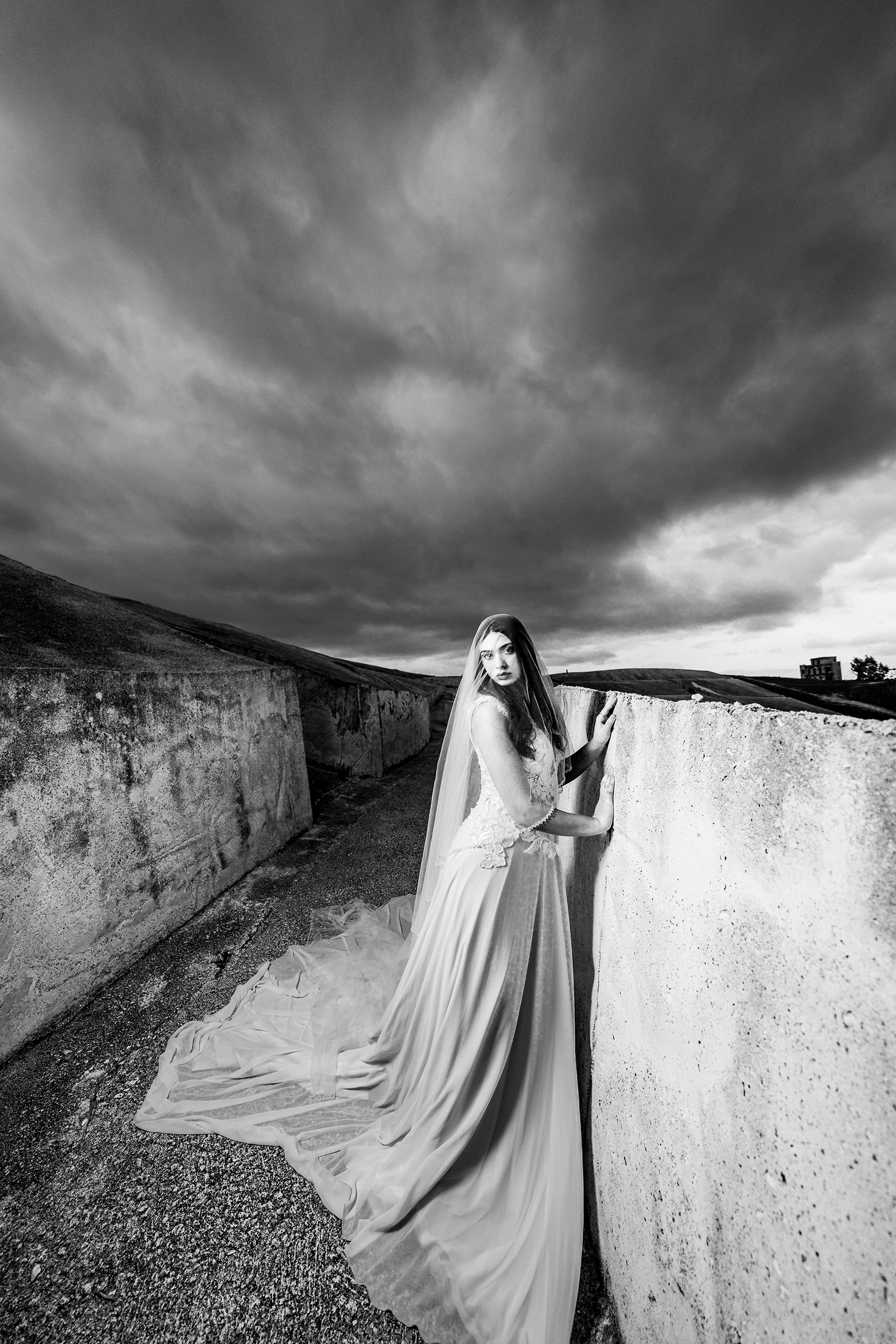 © Cristiano Ostinelli | Sony α9 III + FE 12-24mm f/2.8 GM | 1/4000s @ f/3.5, ISO 250
Using the exposure compensation feature on his Sony Alpha 9 III, he dialled it down to -2.3EV, in turn reducing the shutter speed to 1/4000sec at f/3.5. “This makes the sky much darker, while the flash becomes the brightest element,” Cristiano explains. “But I can only do that thanks to the Alpha 9 III’s global shutter. This lets me combine flash with any shutter speed, meaning I can still work at wide apertures, even in bright light. Cameras with regular shutters are limited to speeds like 1/250s, or have to use High Speed Sync flash which doesn’t have enough energy to overpower the sunshine.”
Wanting to combine the drama of the scene with his subject, Cristiano also opted to use the FE 12-24mm f/2.8 GM lens. “I love that lens as it can give real context to a scene,” he explains, “although like any ultra wide-angle, it has to be used carefully for portraits. One step too close or place the subject too near to the edge and the perspective stretches them unnaturally. You also need to hold it level, not tilted. But do it right and it’s an incredible way to frame a person in the landscape.”
“I shoot weddings most of the time,” Cristiano finishes, “and although I get to be creative in those, a personal project like this is where I can really let my ideas take flight and improvise. A camera like the Alpha 9 III gives me lift-off.”
Featured products


Cristiano Ostinelli | Italy
"My best photograph is the one I have not yet taken"


