Image Focus
Frank Doorhof | Janaika
In movie making and theatre, there’s an important phrase: ‘Mise en scene’. It is the composition of visible elements that build meaning and mood on a stage or set. It is the setting, costumes, props and makeup, the actors’ expressions and performance. But also, perhaps most crucially, it is the lighting and colour. These things communicate your vision to the viewer.
“It’s the same with photography,” says Frank Doohof, an expert in creating a mood. “Movies are a great place to learn the skill,” he continues, “just watch a good one and analyse it. Ask yourself what you’re feeling, then deconstruct the colour and lighting that is used.”
Here, Frank’s model, Janaika, takes on the romantic allure of a leading lady from the golden age of Hollywood. “We chose it all,” he explains. “The lighting is soft and warm, the set adorned with vintage style curtains, and she’s dressed in an evening gown and fur wrap, lounging in an antique armchair. Colour is so important. Reds and oranges are warm and romantic. Blues are colder, less inviting. The filters you use define the emotions for the viewer.”
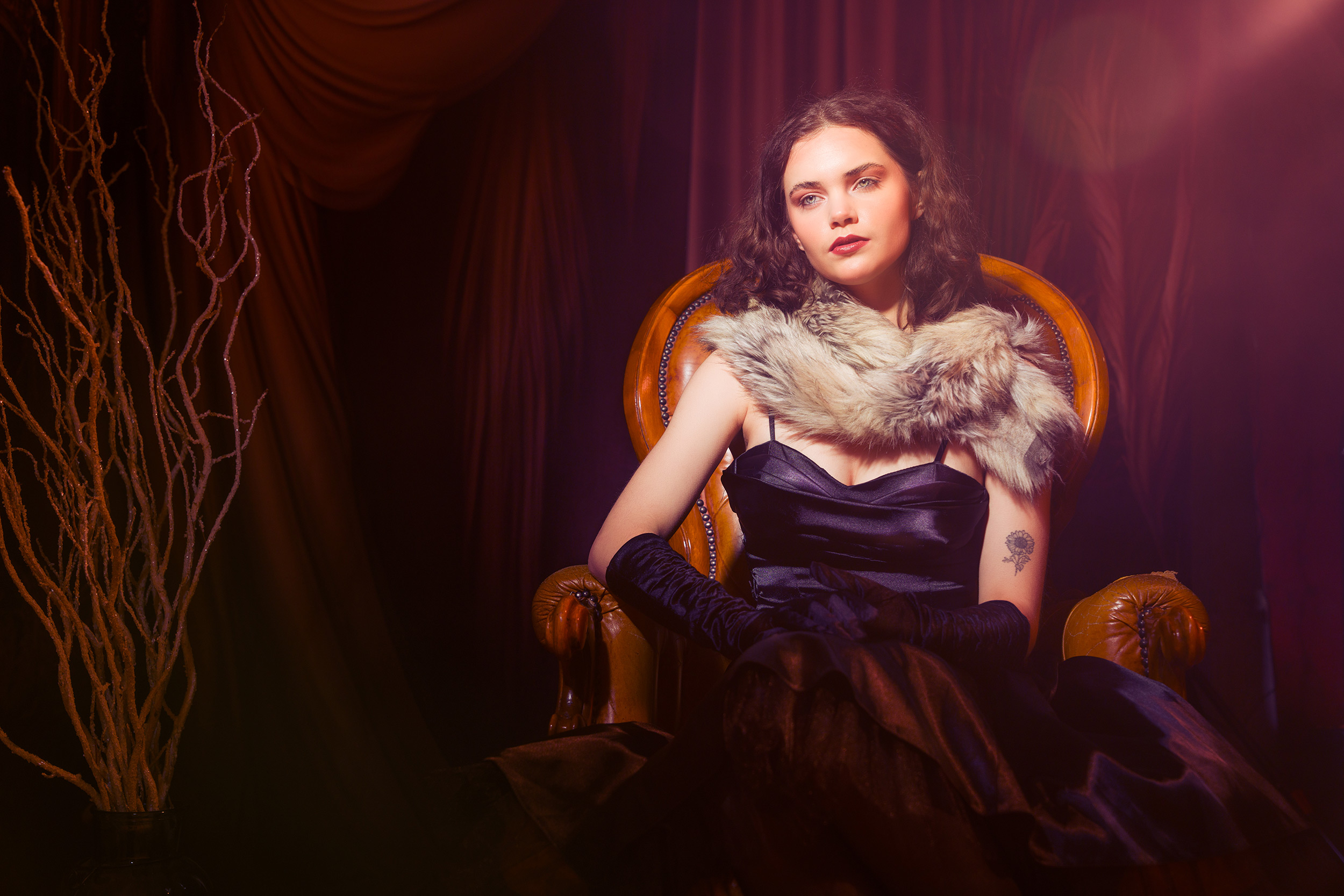 © Frank Doorhof | Sony α7R V + FE 24-70mm f/2.8 GM | 1/125s @ f/4.0, ISO 200
“I set a focused but soft key light from the left of the frame,” Frank explains, “giving the feel of a movie spotlight, while also spilling onto her dress. On the right, another light adds lens flare. For me, it’s always better to do that practically than in editing. The light is a little behind her and aimed back at me, so just the feathered edge is catching her, making it soft and subtle.”
“The focus of the key light is really important,” Frank continues, “because along with its angle, it gives volume and shape to the subject, while the flare ties her and the background together with a wash of soft colour. It’s like creative glue!”
Frank used his Sony Alpha 7R V, a camera he finds just as effective on location or in the studio. “What Sony has done in the last few years is insane,” he says, “especially in aspects like autofocus. The Alpha 7R V can pick up a subject’s eye in almost any conditions, even in the studio with strong backlight and haze.”
“I also love the efficiency of its EVF,” Frank continues. “Outside, I use its Setting Effect mode, so what you see is what you get. I switch it off under strobes, because obviously at 1/125sec, f/16 and ISO 100, you won’t see anything. The camera makes it easy to toggle between the two by adding it to my quick menu.”
“The FE 24-70mm f/2.8 GM is great for portraits, because it gives you options,” Frank says. “Go wide for background and context, or short telephoto if you want compression and isolation. It’s designed to do a lot of creative stuff. For shots like this, I add a black mist filter to soften the backlighting, increasing the romantic feel.”
“Learning what lighting and colour do to the mood of a picture is vital for portrait photographers,” Frank finishes. “It’s like a language that you use to communicate meaning. Sony kit makes that language even easier to learn.”
Featured products


Frank Doorhof | Netherlands
"Why fake it when you can create it"


